
Is Your Therapy Practice Profitable—Or Just Busy? Take This Free Assessment
Is Your Therapy Practice Profitable—Or Just Busy? Take This Free Assessment
Running a mental health practice in New Jersey comes with unique challenges. Between navigating insurance credentialing with Horizon, AmeriHealth, and Aetna, managing multi-office overhead across Bergen or Essex counties, and dealing with New Jersey's complex tax requirements, it's easy to lose sight of whether your practice is actually making money—or just keeping you overwhelmed.
You became a therapist to help clients, not to drown in spreadsheets. But ignoring the financial side doesn't make it go away—it just makes it more expensive.
The Problem: Busy Doesn't Equal Profitable
Most mental health practitioners I work with can tell me their weekly client hours. Few can tell me their profit margin per session after accounting for:
Insurance reimbursement delays and denials
Office rent and utilities across multiple locations
Administrative staff salaries and payroll taxes
Continuing education requirements and licensing fees
Software subscriptions for EHR, billing, telehealth, and scheduling
If you're working 40+ hours a week but barely breaking even, something's broken. And it's probably not your clinical skills—it's your financial strategy.
What Gets Measured Gets Managed
You can't fix what you can't see. Before making any changes to your practice model—whether that's raising rates, dropping insurance panels, hiring associates, or expanding services—you need baseline clarity on where you stand financially right now.
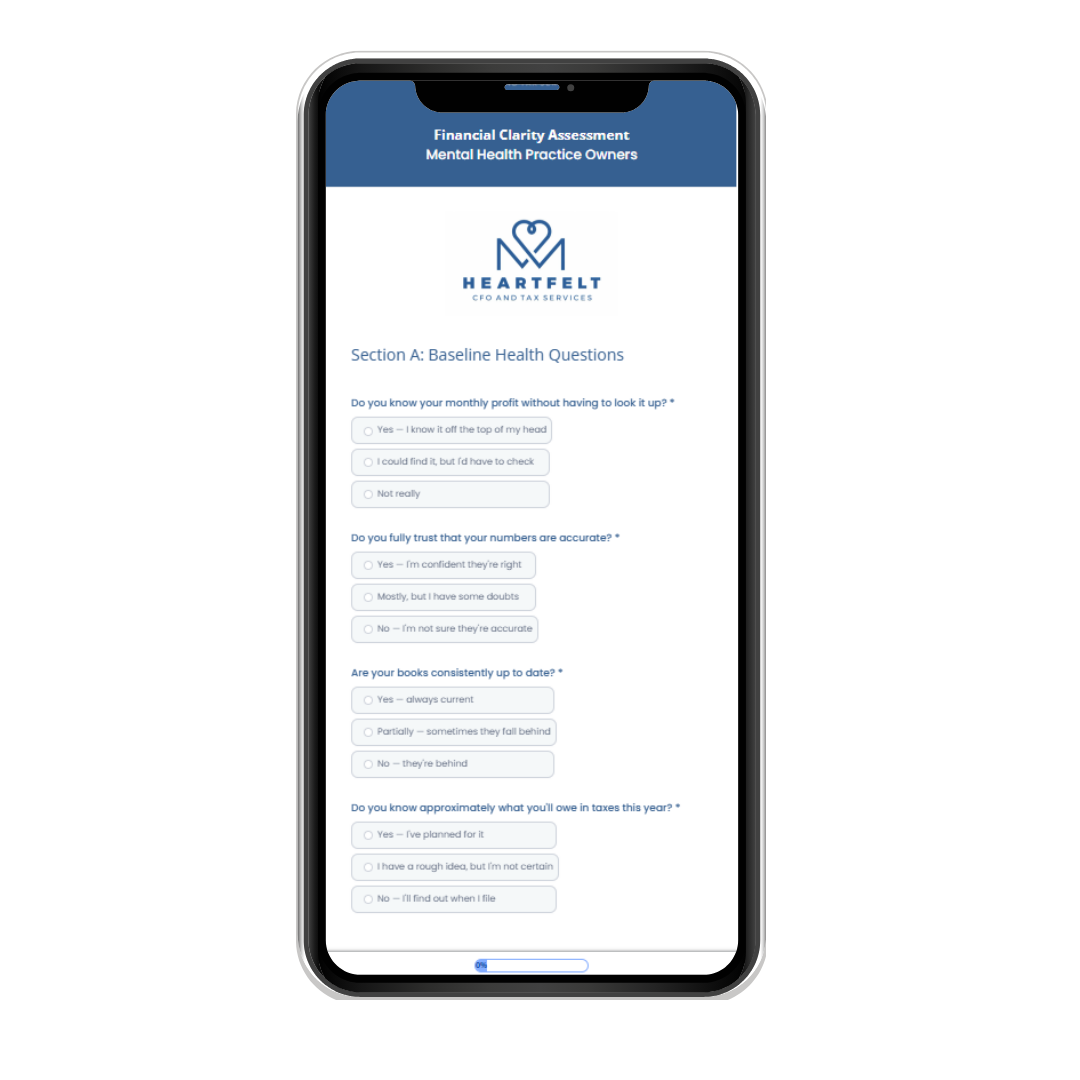
That's what this assessment does. It asks targeted questions that reveal:
Whether you're actually profitable or subsidizing your practice with savings
If your current insurance mix makes financial sense
Where money is leaking out of your practice
What your next growth move should be based on your current numbers
The assessment takes 10 minutes. The insights last years.
Built By Someone Who Actually Works With Therapists
This isn't generic business advice. These questions come from years of working specifically with mental health practitioners in New York and New Jersey—solo therapists transitioning to cash-pay models, group practices scaling across multiple counties, and hybrid practices trying to balance insurance revenue with private-pay growth.
The questions are designed to surface the specific financial decisions that determine whether a therapy practice thrives or burns out its founder.
Take the Assessment
Ready to get clarity? The assessment is free, confidential, and built specifically for mental health practitioners.
Start here:
Financial Clarity for Mental Health Practitioners: Your First Step to Building a Sustainable Practice
At the end, you'll receive personalized recommendations based on your specific practice model, overhead structure, and growth goals. No sales pitch. Just actionable next steps.
Because running a profitable practice shouldn't require a finance degree—just the right questions and someone who knows your industry well enough to ask them.
Take the Assessment
Ready to get clarity? The assessment is free, confidential, and built specifically for mental health practitioners.
Start here:
At the end, you'll receive personalized recommendations based on your specific practice model, overhead structure, and growth goals. No sales pitch. Just actionable next steps.
Because running a profitable practice shouldn't require a finance degree—just the right questions and someone who knows your industry well enough to ask them.
